

Your bite affects much more than the way your teeth come together. The way your upper and lower teeth contact when you close your mouth, chew, and move your jaw can influence how forces are distributed across your teeth, restorations, muscles, and jaw joints.
In dentistry, this relationship is known as occlusion.
At David A. Rice, DDS, we take occlusion seriously because a healthy smile should not only look good—it should also function comfortably and predictably. Dr. David Rice has completed extensive advanced education in restorative dentistry and occlusion, allowing him to evaluate not simply individual teeth, but how your entire bite works together.
When an imbalance in the bite is contributing to dental problems, occlusal adjustment, sometimes called a bite adjustment or equilibration, may be one of the first issues Dr. Rice addresses.
What Is Dental Occlusion?
Dental occlusion describes how your upper and lower teeth meet when your jaws close and how those teeth interact as your jaw moves.
Ideally, biting forces are distributed appropriately throughout the mouth rather than being concentrated on only a few teeth. When certain teeth contact too heavily or too early, the imbalance can place unnecessary stress on teeth, dental restorations, supporting tissues, and the muscles involved in chewing.
Because the bite is a dynamic system, evaluating occlusion involves more than simply asking whether your teeth “fit together.” Dr. Rice considers how the teeth, jaw joints, and chewing muscles work as a whole.
Why Does Your Bite Matter?
A properly balanced bite can help support the long-term health and function of your smile. Depending on the individual patient, appropriate occlusion can help:
- Distribute biting and chewing forces more evenly
- Reduce excessive wear on individual teeth
- Protect teeth from repeated chipping or cracking caused by unfavorable forces
- Help crowns, bridges, veneers, and other restorations function predictably
- Reduce unnecessary stress on the supporting structures around the teeth
- Support comfortable jaw movement and chewing
- Maintain efficient chewing function
- Make it easier to maintain healthy, functional teeth over the long term
For patients undergoing extensive restorative treatment, understanding the bite can be particularly important. A beautifully restored tooth still has to function within the forces created every time you bite and chew.
How Do I Know If My Bite Should Be Evaluated?
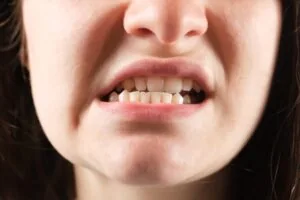
Problems with occlusion are not always obvious. You may simply notice that something feels uneven when you close your mouth, or you may experience repeated problems with individual teeth or restorations.
Dr. Rice may recommend evaluating your bite if you have signs such as excessive or uneven tooth wear, recurring chipped or cracked teeth, restorations that repeatedly experience heavy stress, teeth that seem to contact before the rest of your bite, or discomfort associated with jaw function.
Not every dental concern is caused by occlusion, and not everyone needs a bite adjustment. That is why a careful evaluation is important before treatment is recommended.
What Is an Occlusal Adjustment?
An occlusal adjustment is a carefully planned process used to improve the way the teeth contact one another and distribute biting forces.
This is not simply a matter of randomly “grinding down” teeth until the bite feels different. Dr. Rice approaches occlusion systematically, allowing him to observe how the jaw and muscles respond before making precise changes.
At our office, occlusal adjustments are typically completed in two main phases approximately one week apart, followed when necessary by one to three shorter appointments for fine-tuning.
What Can I Expect During Bite Adjustment?
During the first phase, Dr. Rice may add material to selected natural teeth, commonly in the back of the mouth, to temporarily change where the teeth contact and “open” the bite.
You will then function with this temporary bite relationship for approximately one week. This period allows the muscles involved in jaw movement to adapt or “deprogram,” giving Dr. Rice additional information about your natural jaw position and how your bite should be balanced.
At the second appointment, he begins carefully refining the contacts. Small amounts of the added material are adjusted until biting forces feel more evenly distributed.
Because occlusion involves extremely fine changes, Dr. Rice prefers a conservative approach. Rather than removing too much at once, additional brief appointments may be scheduled so you can experience the new bite during normal chewing and speaking and report anything that still feels uneven.
The goal is a bite that feels natural, balanced, and comfortable—not simply one that feels different when you leave the dental chair.
Occlusion and Restorative Dentistry

Occlusion becomes especially important when repairing or rebuilding teeth.
Crowns, bridges, veneers, dental implants, dentures, and full-mouth reconstruction all have to withstand the forces generated by the bite. If those forces are poorly distributed, even excellent restorative dentistry may be subjected to unnecessary stress.
Dr. Rice’s extensive background in restorative dentistry allows him to consider both sides of the equation: how a restoration should look and how it needs to function within your individual bite.
Dr. Rice is an inducted member of the American Academy of Restorative Dentistry and a Mentor/Clinical Instructor at the Kois Center, where his role includes providing guidance to other dentists in restorative techniques.
How Occlusion Relates to CQR Dentures
Occlusion is also an important part of the advanced CQR denture approach offered by Dr. Rice.
Traditional denture fabrication must recreate a functional bite even though a patient’s natural teeth are no longer present. CQR takes a highly individualized approach by recording how the patient’s jaw actually moves and using that information when developing the denture.
The CQR system uses specialized dynamic bite records and a Condor articulator to reproduce individual jaw movement rather than designing the denture around a purely static relationship. The system is based on three-dimensional movement of the patient’s jaw.
By incorporating that individualized occlusal information into the denture design, CQR dentures are intended to provide improved stability and function while chewing. For appropriate patients, that can mean greater confidence when eating, speaking, smiling, and laughing.
Learn More About CQR Dentures →Advanced Training in Occlusion and Restorative Dentistry

Occlusion is an area in which experience and advanced education matter. Dr. Rice has devoted substantial continuing education to understanding restorative dentistry, bite relationships, and how the teeth and jaws function together.
In addition to his role as a Kois Center Mentor/Clinical Instructor and membership in the American Academy of Restorative Dentistry, Dr. Rice is a member of the American Equilibration Society, an organization focused on the study of occlusion, temporomandibular joints, and related areas of dentistry.
That knowledge allows Dr. Rice to look beyond an individual tooth and consider how treatment will function as part of your complete oral system.
Is Your Bite Working the Way It Should?
If your bite feels uneven, your teeth are experiencing unusual wear, or you have experienced repeated problems with damaged teeth or restorations, an occlusal evaluation may help determine whether the way your teeth come together is contributing to the problem.
Contact David A. Rice, DDS in Elgin, IL to schedule an evaluation and learn whether occlusal adjustment may be appropriate for you.
Schedule a Consultation →